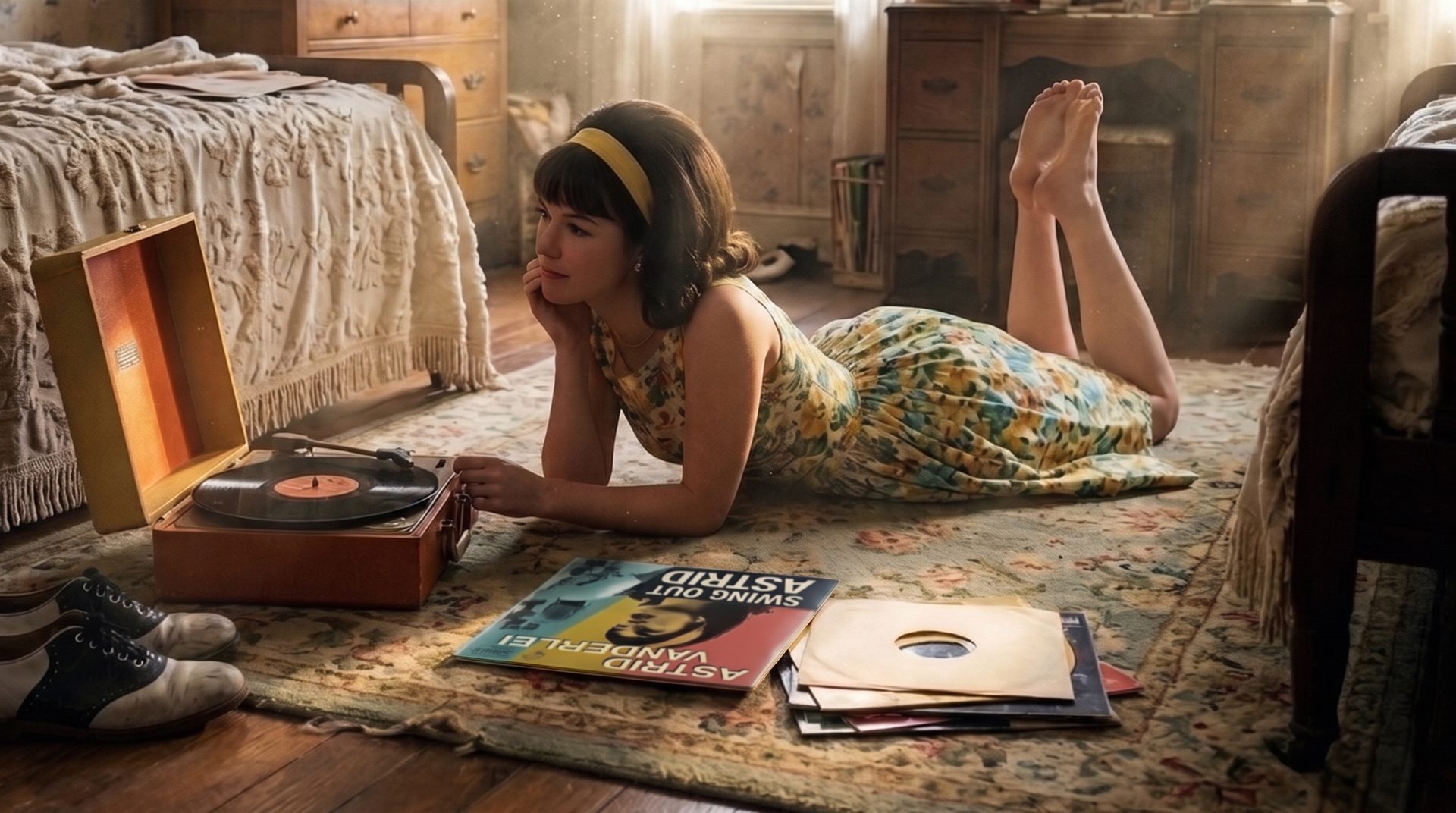
A young woman in a floral sundress lies on her stomach on a bedroom rug beside a portable record player and the Swing Out Astrid sleeve, illuminated by warm morning window light.
Album cover: Astrid Vanderlei in a yellow headband looking up beside a vintage microphone, in halftone over red, yellow and aqua bands, with the title Swing Out Astrid.

Meia-Noite Records presents

Astrid Vanderlei Swing Out Astrid

There is an hour in the late Caribbean afternoon when the shadows of royal palms stretch across turquoise pool tiles like sundial hands, pointing straight toward the hotel bar.

At the El San Juan, the ice in the highball glasses melts at a gentleman’s pace. Men in cream linen suits and tortoiseshell sunglasses sit beneath striped canvas awnings, talking gold transfers and shipping manifests in hushed, unhurried voices. Nobody asks where the money came from, and nobody asks which passport is in the breast pocket. Everyone understands the house rules: you can live right on the razor’s edge of the law, provided you do it with manners immaculate, trousers creased ... and a fresh daiquiri within reach. This record is a soundtrack to that hour.

  • Stereo
  • High fidelity
  • LPS-3024
  • 10 tracks · 39 minutes

33⅓ RPM · MICROGROOVE

High-Fidelity Tracks

Press play and the record keeps turning while you read on.
It runs from daylight struttin’ to 2 a.m. transit.

Side A

The Daylight Swag

  1. Um Pouquinho

    Duration 5:24

    A masterclass in Wanderley-style buoyancy. The Hammond keys click with champagne fizz while an intimate vocal whispers in Portuguese like a secret passed across a roulette table.

    Lyrics

    Verse 1Sun on the water, sand on my feet
    He’s on the corner, looking so sweet
    I didn’t say hello, I barely said a word
    I only sighed a little, I don’t think he heard

    ChorusUm pouquinho, just a little
    A little bit of him, a little bit of sun
    Um pouquinho, just a little
    Is it only summer, or could it be someone?

    Verse 2Waves keep on coming, waves go away
    Like all of those things that I wanTed to say
    Tomorrow I’ll be brave, tomorrow I will try
    Today I only watch him walk on by

    ChorusUm pouquinho, just a little
    A little bit of him, a little bit of sun
    Um pouquinho, just a little
    Is it only summer, or could he be the one?

    BridgeAi, que saudade... Can I miss a kiss we never had?
    Ai, que saudade... A little bit happy, a little bit sad.

    ChorusUm pouquinho, just a little
    A little bit of him, a little bit of sun
    Um pouquinho, just a little
    The sweetest summer that never even begun

    OutroUm pouquinho, just a little.
    He doesn’t see me, just a little.
    Um pouquinho, just a little.

  2. The tempo climbs. Brushes swirl, the acoustic bass walks with athletic bounce, and the phrasing glides effortlessly between Portuguese and English. Pure jet-set sunshine by the hotel pool.

    Lyrics

    Verse 1The sun is high, the air is still
    I turn the glass upon the sill
    One cube of ice goes drifting by
    And there he is in a soft clear sky

    Verse 2It spins and spins around, around, around
    A silver dream without a sound
    He circles far beyond my hand
    A little moon above the sand

    ChorusRound and round he goes, he goes
    Through the haze where the warm wind blows and blows
    Every clink is a little sigh
    Talvez amanhã... he’ll pass me by

    Verse 3The glass is wide, the ice is small
    He keeps on turning through it all
    I close my eyes, the room is a daze
    And he is a dream in the summer haze

    BridgeA wheel of light, a ring of lime
    I watch him glide through the slow, sweet time
    He turns away, I lose my way
    Half awake in the heat of day

    Verse 4The sun leans low, the day grows thin
    The ice gives way and I begin
    To turn the glass where he has been
    The water stays, still cool within

    Chorus: Modulated Key ChangeRound and round he goes, he goes
    Through the haze where the warm wind blows and blows
    Every clink is a little sigh
    Talvez nunca? He’ll pass me by

    OutroRound and round... round and round...
    que saudades.
    In a dream. In a daze.
    Let him go. Let him go. Go. Go.

  3. Widescreen Technicolor from the very first bar. Opening with a Mancini-worthy vibraphone and brass fanfare, it rides a buoyant Brasil ‘66 groove from morning light in Leblon through a rapid-fire flute, guitar, and vibraphone showcase in Ipanema to a soaring Swing Out Sister-style orchestral crescendo under the evening lights of Copacabana.

    Lyrics

    Verse 1Leblon’s morning, silver light
    Hush of water, soft and white
    Salt in the air, sun on my skin
    Let the day come drifting in

    ChorusNice and slow, the waves roll in
    Nice and slow, then out again
    Nothing to chase, nowhere to be
    Just the sun ... the sand, and the sea
    (the sun, the sand, the sea)
    (the sun, the sand, the sea)

    Verse 2Ipanema in the afternoon
    Golden sand and a drowsy tune
    Sails drift by and drift away
    Blue on blue on blue all day

    ChorusNice and slow, the waves roll in
    Nice and slow, then out again
    Nothing to chase, nowhere to be
    Just the sun ... the sand, and the sea
    (the sun, the sand, the sea)
    (the sun, the sand, the sea)

    BridgeCopacabana in the evening light
    Gold fades to pink, pink fades to night
    Copacabana, evening glow
    Warm as a sigh, and soft and slow

    ChorusNice and slow, the waves roll in
    Nice and slow, then out again
    Nothing to chase, nowhere to be
    Just the sun ... the sand, and the sea
    (the sun, the sand, the sea)
    (the sun, the sand, the sea)

    OutroSo... nice and slow...
    In...
    And out again...

  4. Hold the Line

    Duration 3:51

    A cheeky nod to late-60s pop-bossa crossover — think Burt Bacharach arranging for Sérgio Mendes on the A&M lot. Crisp, punchy, and instantly addictive.

    Lyrics

    Verse 1The lights come on along the bay
    The pool turns blue, then turns to gray
    The waiter smiles and walks on by
    I watch the phone and wonder why

    Verse 2The operator knows my name
    She says it soft, she plays the game
    "No word yet, miss, but stay a while"
    I answer with a practiced smile

    ChorusHold the line, hold the line
    The night is warm, the stars align
    Um momentinho, I can wait
    Maybe it’s early, maybe it’s late

    Verse 3The band plays soft down by the shore
    A tune I’ve heard somewhere before
    I lift the phone and let it be
    Whoever calls can wait for me

    ChorusHold the line, hold the line
    The night is warm, the stars align
    Um momentinho, I can wait
    Maybe it’s early, maybe it’s late

    BridgeAlô. Um momento, por favor.

    Verse 4Somewhere a door swings wide
    Somewhere a car pulls out
    The whole hotel is dreaming
    Of what the night’s about

    Final ChorusHold the line, hold the line
    The night is warm, the stars align
    Um momentinho, we can wait
    Maybe it’s early, maybe it’s late

    OutroHold the line. Hold the line.
    Alô
    Hold the line.

  5. Boarding Pass

    Duration 2:56

    The departure gate is called and the pace kicks into overdrive. A whirlwind of Wanderleyesque organ bravura and breathless, wordless scatting — bouncy, buoyant, and brimming with the kinetic thrill of racing through a sunlit terminal, ticket in hand.

    Lyrics

    ThemeÊ ê, ba-da-ba, ê ê
    Ra-ta-ta, ba-da-ba, la la la

    ChantÊ, ô! Ê, ô!
    Ba-ra-ba-ra, ê ê ê

    Final ChorusÊ ê, ba-da-ba, ê ê!

Side B

The Midnight Turn

  1. I Like It This Way

    Duration 3:16

    Intimate groove at 108 BPM, where playful Hammond glissandos, xylophone runs, and sweeping Hollywood strings wrap around a coy, whispered confession delivered with a wink and a half-smile.

    Lyrics

    Verse 1Him and I, along the sea,
    He’s my Daddy, the man for me
    Daddy says I belong to him,
    He’s strong enough to rein me in.

    ChorusHe says sit. I sit.
    (I sit)
    He says stay. I stay.
    (I stay)
    He doesn’t know
    I like it this way.

    Verse 2Daddy holds me with his hands,
    I go wherever he demands.
    A step or two, always behind,
    I follow his rules, in my mind.

    ChorusHe says sit. I sit.
    (I sit)
    He says stay. I stay.
    (I stay)
    He doesn’t know
    I like it this way.

    BridgeEyes down, and on my knees,
    waiting for his orders,
    eager to obey,
    to let him have his way

    Final ChorusHe says sit. I sit.
    (I sit)
    He says stay. I stay.
    (I stay)
    I think he knows
    I like it this way.
    I am his good girl.
    (good girl)

    OutroHis good little girl.
    (His good little girl.)
    His good little girl.
    His good little girl.
    And yes, he knows:
    I like it this way.
    Daddy knows.

  2. Cocktail Hour

    Duration 4:00

    The pivot from afternoon sun to lobby-bar dusk. The clicking keys melt into warm Hammond drawbar pads, a French horn sighs in the corners of the room, and our narrator watches the revolving door with an untouched pink drink in hand and a chorus of international toasts answering her across the marble floor.

    Lyrics

    Verse 1Different clock, different town,
    I keep my coat on, I sit down.
    A pink drink with a pretty name,
    every lobby looks the same.

    ChorusSo raise it to the night,
    to the lobby and the light,
    (Sha-la-la la-la!)
    Raise it to the sea,
    to the someone I might be.
    (Sha-la-la, la-la!)

    Verse 2Different coin, different door,
    I’ve been here, I think, before.
    A stranger smiles, I look away,
    Love can wait another day.

    ChorusSo raise it to the night,
    to the lobby and the light,
    (Sha-la-la la-la!)
    Raise it to the sea,
    to the someone I might be.
    (Sha-la-la, la-la!)

    ChorusSo raise it to the night,
    to the lobby and the light,
    (Sha-la-la la-la!)
    Raise it to the sea,
    to the someone I could be.
    (Sha-la-la, la-la-la!)

    Final ChorusSo raise it to the night,
    to the lobby and the light,
    (Sha-la-la la-la!)
    Raise it to the sea,
    to the someone I will be.
    (Sha-la-la, la-la!)
    (Sha-la-la!)

  3. Tudo ou Nada

    Duration 3:36

    Sultry, smoky, and dangerously close-miked. The organ pulls back into long, simmering chords while the vocal lays down a midnight ultimatum with a purr.

    Lyrics

    Verse 1The coat is pressed, the hour is near
    I order something light and clear
    A friendly nod, a folded sheet
    The clock is slow, my pulse is neat

    Verse 2Somewhere a door, somewhere a line
    Somewhere a number, yours or mine
    I keep my hands upon my knee
    Whatever comes will come to me

    ChorusAny minute, any minute now
    It all comes down, and I don’t know how
    Tudo ou nada, sweet and light
    Either way, it’s a lovely night

    Verse 3All I have is out of sight
    Riding on the turn of night
    I could laugh, I could cry
    I just smile and watch it fly

    ChorusAny minute, any minute now
    It all comes down, and I don’t know how
    Tudo ou nada, sweet and light
    Either way, it’s a lovely night

    BridgeSem volta, agora, tudo ou nada.
    A hush, a click, a held-in breath
    A sleeping line from life to death
    One more breath, one more bell
    Nobody here will ever tell

    Final ChorusAny minute, any minute now
    It all comes down, and I don’t know how
    Tudo ou nada, sweet and light
    Either way, it’s a lovely night

    OutroAny minute, any minute now.
    Tudo ou nada.
    Either way. Either way.
    A lovely night.

  4. Gone is the tropical sunshine; in its place enters a lush, melancholy Claus Ogerman-style tapestry of swelling strings, a solitary flugelhorn answering the organ, and a xylophone that ticks like a departure board in an airport transit lounge at 2 a.m., always on the move to ... somewhere.

    Lyrics

    Verse 1Somewhere tonight he’s waiting,
    Somewhere across the sea.
    Another town, another train,
    Could HE be THERE for me?

    Verse 2Somewhere tonight he’s sleeping,
    Somewhere beyond the rain.
    Another gate, another flight,
    And I’m moving on again.

    ChorusIf I go, will I find him?
    If I stay, will he come?
    The clock of time keeps turning,
    And the night has just begun.

    Verse 3Somewhere tonight he’s waiting,
    And so, it seems, am I.
    One more drink, one more goodnight,
    He’s somewhere ... tonight.
    (Somewhere tonight)
    (Somewhere tonight)

    ChorusIf I go, will I find him?
    If I stay, will he come?
    The clock of time keeps turning,
    And the night has just begun.

    ChorusIf I go, will I find him?
    If I stay, will he come?
    The clock of time keeps turning,
    And the night has just begun.

  5. A Light Left On

    Duration 2:56

    The rare, intimate exhale at the end of the journey — a tender, swaying 3/4 bossa waltz that answers the nomadic ache of "Somewhere." Over brushed triple-meter swing and warm, ocean-breeze orchestration, there’s a little place by the sea where, one day, the suitcase can finally be put away.

    Lyrics

    Verse 1Someday there’ll be a little house,
    A window by the sea,
    A porch where the tide comes in,
    A light left on for me.

    Verse 2No more gates, no more midnight trains,
    No more hotel room keys,
    Just the morning sun on a simple wall,
    And a slow, warm salty breeze.

    BridgeTill then I’ll carry it inside,
    Through every foreign town,
    And one soft night, without a sound,
    I’ll set my suitcase down.

    Verse 3Someday there’ll be a little house,
    A window by the sea,
    A porch where the tide comes in,
    A light left on for me.

    Verse 4Someday, a little house,
    A place where I can be,
    A little light left on just for me.

    Outro(A light left on)
    (A light left on for me)

Filmic Scores

Official Music Videos

  • Round and Round

    Side A · Track 2 · 4:49

    Jet-set sunshine by the hotel pool: palms, a yellow dress and one cube of ice going round and round.

  • Leblon to Copacabana

    Side A · Track 3 · 3:51

    Stroll along the Rio shoreline, from morning light in Leblon to the evening lights of Copacabana.

  • Somewhere

    Side B · Track 9 · 4:10

    A nod to noir, right around midnight: night trains, rain-streaked glass and the last flight out.

Liner Notes

Bossa With Swing and a Wink

Walter Wanderley's tropical bounce

Most American listeners first met bossa nova through Stan Getz, Antônio Carlos Jobim, and João Gilberto: hushed, brooding, collegiate, and serious as an existentialist café on a rainy Tuesday. That purist school had its charms, but it was for staring into an espresso cup and contemplating saudade with a single acoustic guitar.

Meanwhile, down in Rio de Janeiro, in the smoky subterranean boîtes of Beco das Garrafas, another sound was bubbling up: one that traded melancholy for a broad grin, a wicked wink, and a rhythmic hip-sway that demanded movement. That was the world of Walter Wanderley, the Brazilian-born pioneer for whom electronic music was a symbol of the jet age.

Wanderley took the heavy church architecture of the Hammond B-3 organ and turned it into a tropical carousel full of bounce and an apparently effortless but hard-riding energy. With his drawbars pulled forward, the percussion tab clicked on, and the Leslie speaker spinning on “chorale,” he popped chords like champagne corks. When producer Creed Taylor brought Wanderley north to New York in 1966 for his legendary Verve run — cutting Rain Forest, Chegança, and his sparkling summit with another transplanted Brazilian, Astrud Gilberto, on A Certain Smile, A Certain Sadness — the organ wasn’t merely accompanying the rhythm section; it was the rhythm section, trading rapid-fire, caffeinated 16th-note runs with flutes, vibraphones, and nylon-string guitars.

In paradise, taking yourself seriously is the only unforgivable faux pas.

That same kinetic DNA sits right at the heart of Swing Out Astrid on tracks like “Um Pouquinho”, “Round and Round”, and “Tudo Ou Nada”: the organ bubbling under the lead line, the cross-stick tapping out a relentless syncopation, and the surdo giving just enough bottom-end thud to keep the feet tapping. This is, in the truest and most delicious sense, “Music to Watch Girls By.” It is music designed for cruising down Avenida Atlântica with the top down on an Alfa Romeo Giulietta Spider, watching the sea breeze catch silk headscarves and sundresses. It never takes itself too seriously, because in paradise, taking yourself seriously is the only unforgivable faux pas.

Read the full liner notesFold the liner notes away

Creed Taylor, Claus Ogerman, and the Verve Jet-Set Machine

To understand why this album favors punchy brass, bright vibraphones, and widescreen momentum over bedroom-acoustic minimalism, look to the mid-century masterminds who hijacked bossa nova and turned it into high-gloss international cinema: Creed Taylor and Claus Ogerman.

Taylor, the visionary architect behind Verve Records (and later A&M/CTI), understood something that the purists missed: bossa nova’s syncopated engine didn’t have to be whispered in a darkened room. It could drive a sports car. In 1963, Taylor paired Danish-born trombonist Kai Winding with German arranger-conductor Claus Ogerman to cut “More”, the film theme from Mondo Cane. What came out of the speakers was pure modernist audacity: a bank of swaggering trombones, electric-bright glockenspiel and vibraphone hooks, an infectious surf-lounge organ pulse, and a rhythm section that strutted like it owned the boulevard.

Ogerman was a magician of velvet and brass. Whether he was scoring Kai Winding’s low-brass hooks or draping Astrud Gilberto in lush, contrapuntal strings and concert flutes on Look to the Rainbow (1966), he knew how to build an arrangement that felt like a 70mm Panavision lens opening from a helicopter over Copacabana. One moment the strings are sighing in long, oceanic waves; the next, a tight horn section or a nimble flute-and-vibraphone trade kicks the doors open and reminds you that the sun is still shining and the convertible is still cruising.

West Coast Sunshine & Technicolor Scores: Brasil ’66, Bacharach, and Mancini

While Verve was perfecting its Manhattan-meets-Rio cocktail on the East Coast, an even sunnier alchemy was taking place on the old Charlie Chaplin soundstages in Hollywood at A&M Records.

There, Herb Alpert and Sérgio Mendes & Brasil ’66 rewrote the rules of cosmopolitan pop. On landmark records like Herb Alpert Presents Sergio Mendes & Brasil ’66, Equinox, and Look Around, Mendes stripped away every trace of sleepy folkloric nostalgia and replaced it with gleaming California studio polish. Even when Brasil ’66 tackled a dreamy ballad, the groove never dragged: the drums snapped, the piano and flute darted through agile, high-velocity unison runs, and two female voices — Lani Hall and Janis Hansen — floated in cool, honeyed unison and call-and-response harmony right over the top.

That West Coast studio brilliance was inseparable from the great film and pop melodists of the era:

  • Academy Award winner Burt Bacharach (6 nominations, 3 Oscars), whose asymmetric phrasing, soaring flugelhorn countermelodies, and chiming vibraphones turned songs like “The Look of Love” into the gold standard of velvet seduction: Brasil ’66, with Janis Hansen at the mic, brought it to the top of the charts, and Dusty Springfield immortalized it as the James Bond film theme for Casino Royale.
  • Academy Award winner Henry Mancini (18 nominations, 4 Oscars), the undisputed king of cinematic widescreen sophistication. Mancini possessed two distinct superpowers, and Swing Out Astrid borrows shamelessly from both: the bright, brassy, glockenspiel-kissed jet-set overture (in arrangements like Two for the Road, Arabesque, and Mr. Lucky), and the intoxicating, slow-burn nocturnal trance of “Lujon” (“Slow Hot Wind”) and “Dreamsville”, where warm French horns and muted brass drift across a velvet string section at twilight.

The Transatlantic Time Machine: Swing Out Sister and the Sophisti-Pop Synthesis

If Swing Out Astrid sounds difficult to pin to any single calendar year — at once too punchy and panoramic to be a dusty 1963 archival relic, yet too lushly orchestrated for modern plastic pop — that is strictly by design.

Its true spiritual compass points toward late-1980s and 1990s London, when Corinne Drewery and Andy Connell formed Swing Out Sister. Across albums like It’s Better to Travel (1987), Kaleidoscope World (1989), and Get in Touch with Yourself (1992), Swing Out Sister pulled off a dazzling sleight of hand. On tracks like “Twilight World”, “Forever Blue”, “You on My Mind”, and “Am I the Same Girl?”, they took the entire mid-60s cosmopolitan playbook, with its suite of Bacharach flugelhorns, Mancini strings, Creed Taylor brass stabs, Walter Wanderley organ bounce, and Brasil ’66 vocal harmonies, and welded it to a sleek, propulsive sophisti-pop rhythm section.

A world of sunny places for shady people.

The result avoided retro pastiche in favor of a timeless, decade-agnostic jet-set universe where it is permanently 5:30 p.m. in a modernist transit lounge somewhere between Rio, Rome, Tokyo, and Montecito; always just one connecting flight away from the Caribbean and with a flexible, open-minded worldview of live and let live; a world of sunny places for shady people. That is the exact frequency this record is tuned to. Intimate, stripped-down breathers do appear on the manifest, like the swaying 3/4 “A Light Left On”, but they are the deliberate midnight exceptions that prove the rule, giving you just enough quiet air before the brass, the organ, and the strings sweep you back out onto the soaring coastal highway with the top down.

The Cosmopolitan Canon: Where This Sound Was Born

Solid style never travels without a pedigree. Every brass fanfare, spinning Leslie chord, and whispered chorus on Swing Out Astrid carries the fingerprints of a transatlantic conspiracy: A circle of Rio organists, European arrangers, Manhattan jazz producers, Hollywood film scorers, and the stylesetters of London’s sophisti-pop who, across oceans and decades, turned mid-century pop with bossa nova roots into a widescreen art form.

To trace that precise DNA back to its source, start with the eight cornerstone masters that built the world this album lives in. Get hold of their original pressings, drop the needle on the heavy vinyl, and keep something cold in a coupe glass while you lean back to listen:

  1. Walter Wanderley — Rain Forest (Verve, 1966)
    Produced by Creed Taylor. The crown jewel of Hammond B-3 bossa nova. Includes the immortal “Summer Samba (So Nice)”, “It’s Easy to Say Good-Bye”, and “Bellevue”, showcasing Wanderley’s percussive drawbar pop and airy flute/organ interplay.
  2. Astrud Gilberto & Walter Wanderley Trio — A Certain Smile, A Certain Sadness (Verve, 1966)
    Produced by Creed Taylor. The direct blueprint for pairing a dry, close-miked, non-vibrato female vocal with a bouncy, unapologetically swinging organ combo.
  3. Kai Winding — Solo / “More” (Theme from Mondo Cane) (Verve, 1963)
    Produced by Creed Taylor; arranged & conducted by Claus Ogerman. Denmark met Germany in this American-recorded Italian film theme which Ogerman and Taylor turned into a propulsive, modernist, trombone-driven highway cruiser filled with glockenspiel, organ, and a large portion of attitude.
  4. Astrud Gilberto — Look to the Rainbow (Verve, 1966)
    Arranged & conducted by Claus Ogerman and Gil Evans. The masterclass in widescreen orchestral bossa: sighing strings, French horns, concert flutes, and vibraphones framing a whisper-quiet voice.
  5. Sérgio Mendes & Brasil ’66 — Herb Alpert Presents Sergio Mendes & Brasil ’66 (1966) & Look Around (A&M, 1968)
    The pinnacle of the West Coast California studio sound: buoyant pop-bossa percussion, agile piano-and-flute runs, and the luminous dual vocals of Lani Hall and Janis Hansen on classics like Burt Bacharach’s “The Look of Love”.
  6. Burt Bacharach — Casino Royale (Original Motion Picture Soundtrack) (Colgems, 1967) & Reach Out (A&M, 1967)
    Playful brass stabs, soaring flugelhorns, shifting meters, and the unmistakable sound of 1960s Technicolor optimism.
  7. Henry Mancini — Mr. Lucky Goes Latin (RCA Victor, 1961) & Two for the Road (RCA Victor, 1967)
    The dual sides of Mancini: Latin-tinged vibraphones, flutes, and brass on one hand, and the most sumptuous, velvet-draped nocturnal string writing (including his masterpiece “Lujon”) ever committed to magnetic tape on the other.
  8. Swing Out Sister — Kaleidoscope World (1989) & Get in Touch with Yourself (Fontana, 1992)
    Where 1960s orchestral cinema met modern sophisti-pop. Tracks like “Forever Blue”, “Twilight World”, “You on My Mind”, and “Am I the Same Girl?” prove that great jet-set orchestration doesn’t belong to the past — it belongs to its own permanent and truly timeless golden hour.
Black-and-white portrait of Astrid Vanderlei in a pale headband and pearl earrings, eyes closed, smiling.
Astrid Vanderlei in the official music video for “Somewhere”

The Astrid Sound

Cool restraint in a loud world

The voice at the center of these sessions does not shout, does not belt, and refuses to plead. Like Astrud herself in that legendary 1963 session at A&R Studios in New York ()and with a nod to the warm California poise of Janis Hansen and the cool, unbothered elegance of Swing Out Sister's Corinne Drewery) she sings with an unadorned intimacy, a quiet conversational coolness that cuts effortlessly through the biggest brass and string orchestrations.

In an era of relentless musical loudness and algorithmic bombast, this album revives a lost art: widescreen glamour paired with the luxury of vocal restraint. It is a record made for linen, sea salt, vintage convertibles, and the quiet thrill of knowing you might just get away with it.

Pour another drink. The night has just begun.

—